Why Boardroom Rivals
The gap between knowing something and doing something with it
I spent 16 years in corporate America. Then I spent the last 10 years building and running my own businesses. The whole time, I watched the same gap show up over and over: the gap between knowing something and being able to do something with it. That gap is why I built Boardroom Rivals.
Here’s what I see going on in business education right now, and why I think simulations are a bigger piece of the answer than most faculty realize.

Founder of Boardroom Rivals · Faculty at Marian University
01 · Theory versus practice
Lectures build knowledge. Practice builds judgment.
Employees and founders have to know their subject. But the people who actually move things forward, the ones who get promoted, close deals and build companies, are the ones who can take knowledge and turn it into judgment under pressure.
Textbooks and lectures build the knowledge layer. They don’t build the judgment layer. Practice does.
- 1.5×
- Students in lecture-only courses were 1.5 times as likely to fail as students in active-learning courses, across 225 studies of college STEM courses.
- Freeman et al., PNAS, 2014
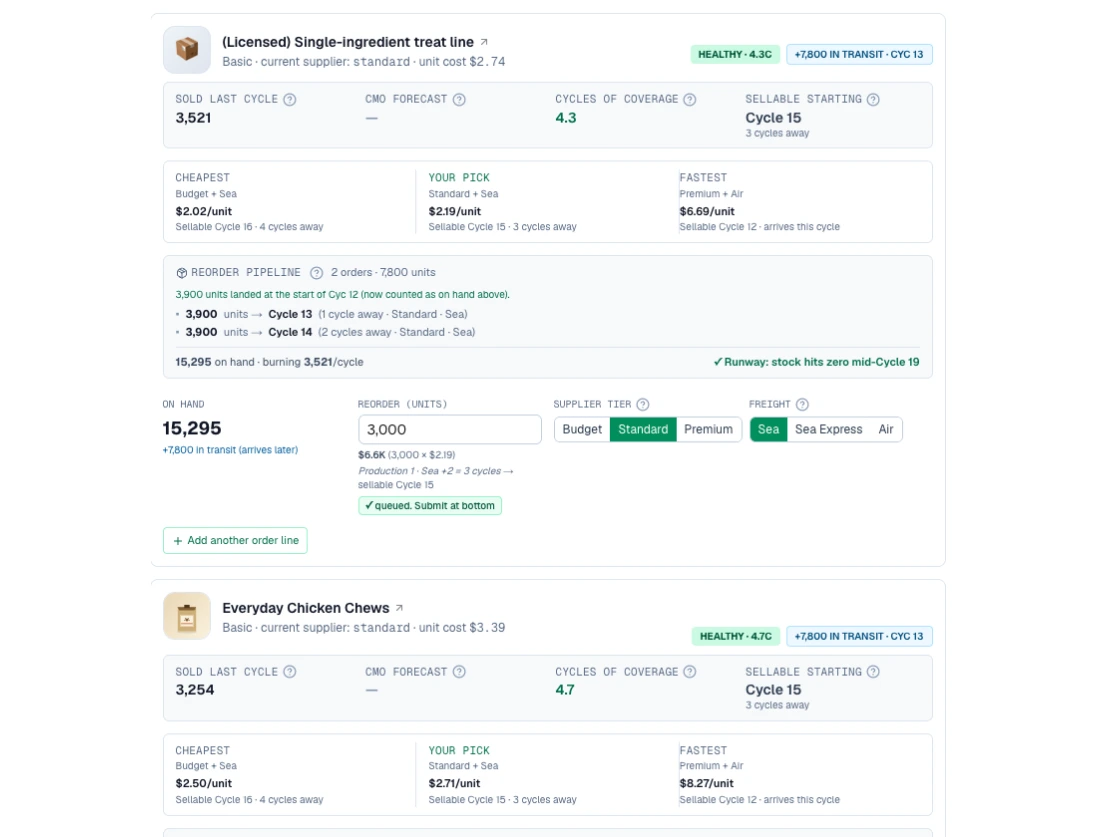
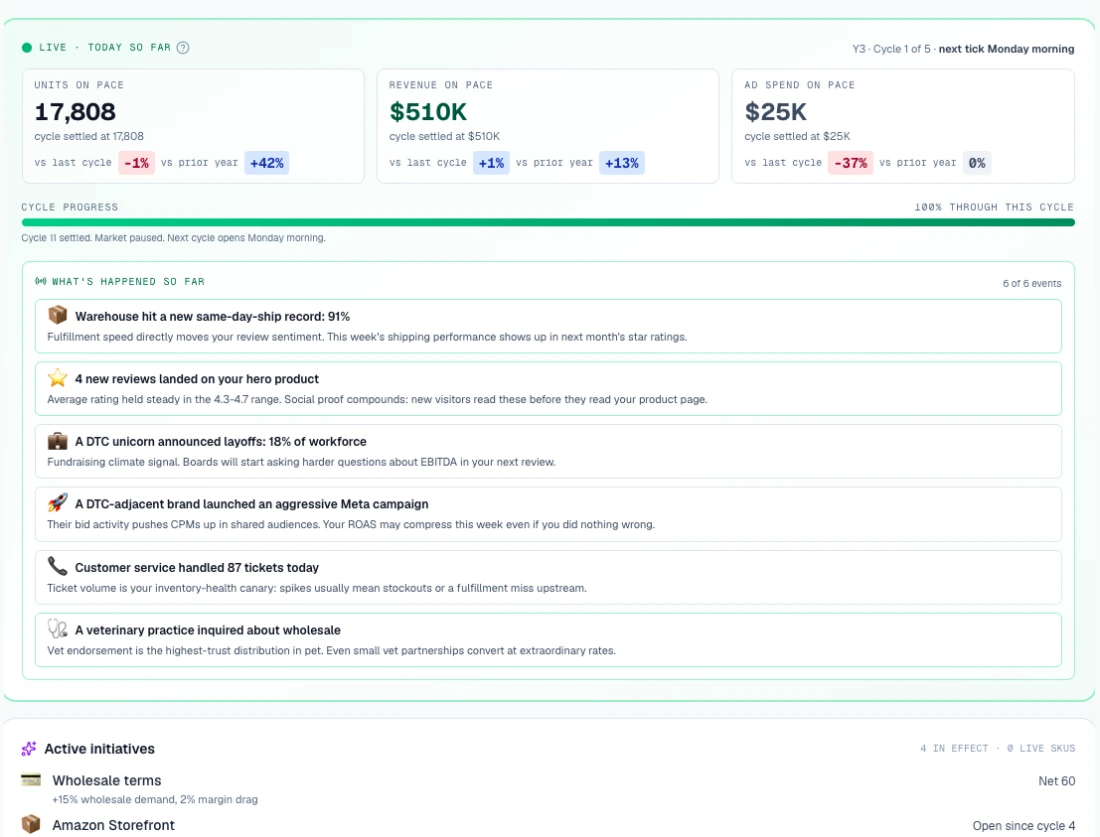
Judgment under pressure: The Boardroom’s COO trades cost against time on every reorder. See The Boardroom
02 · AI
AI can inform a decision. It can’t make it for them.
Over the last two years, students have figured out how to use AI to work around almost every traditional take-home assignment. Which means a lot of what we’re grading in those assignments isn’t the student at all.
Simulations force decisions in real time, with context, under constraints: a place where AI can inform but can’t replace the student’s judgment.
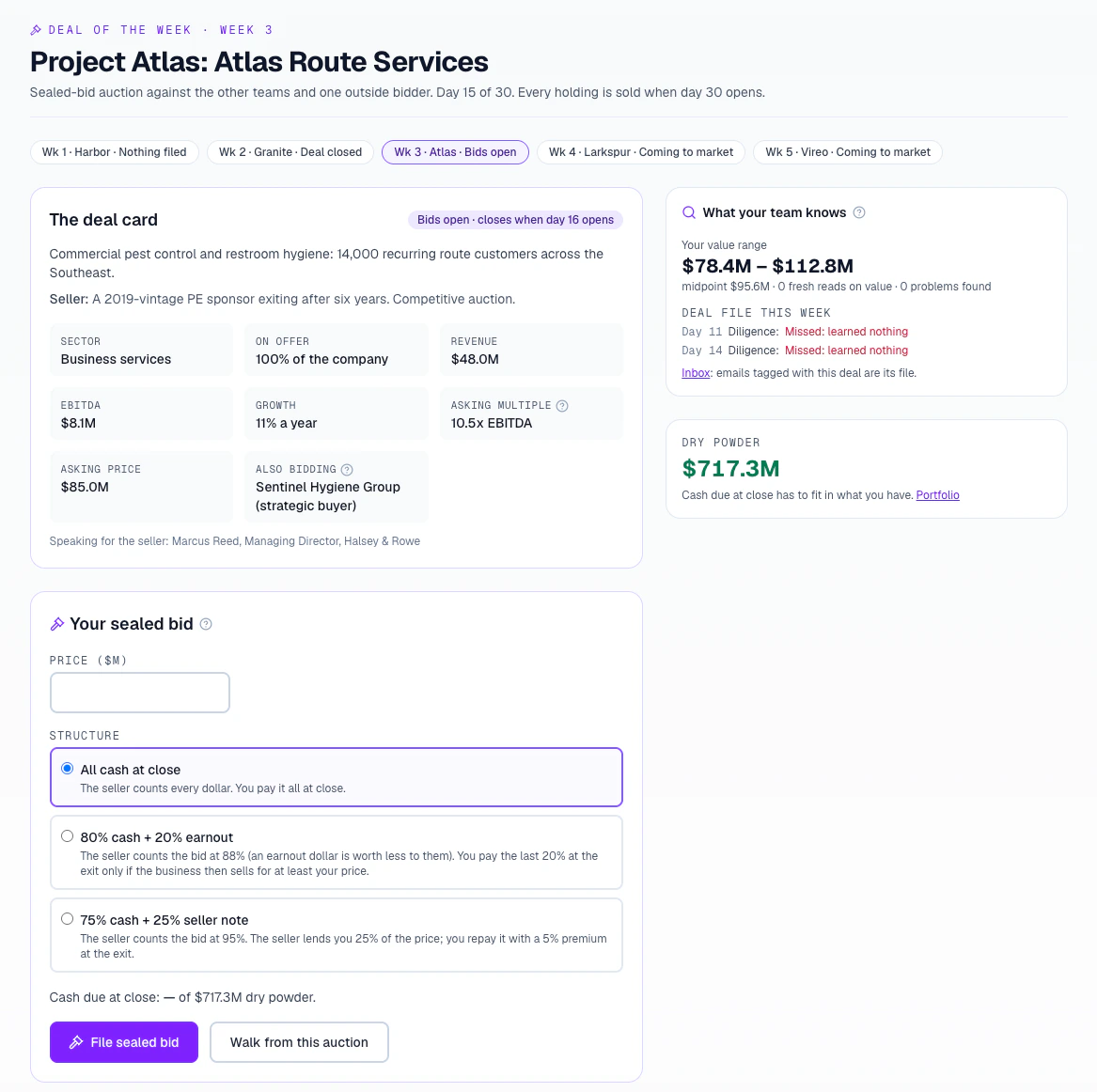
In context, against rivals: every Deal Room team bids on the same company, whose true value stays hidden. See Deal Room
- 57%
- of U.S. college students use AI in their coursework at least weekly.
- Lumina Foundation and Gallup, 2026
- 96 → 48
- An Ivy League economics class averaged 96 on a take-home midterm. On the in-person final, it averaged 48.
- Inside Higher Ed, July 2026
03 · Team projects
Nobody hides in the team.
Team projects have always had the hiding problem. One or two students carry the work, the rest coast, and the grade doesn’t tell you who did what.
In every Boardroom Rivals simulation, every decision each student makes is tracked individually inside the team effort. You see who’s actually leading and who’s riding along. Students know this going in, and the dynamic shifts.
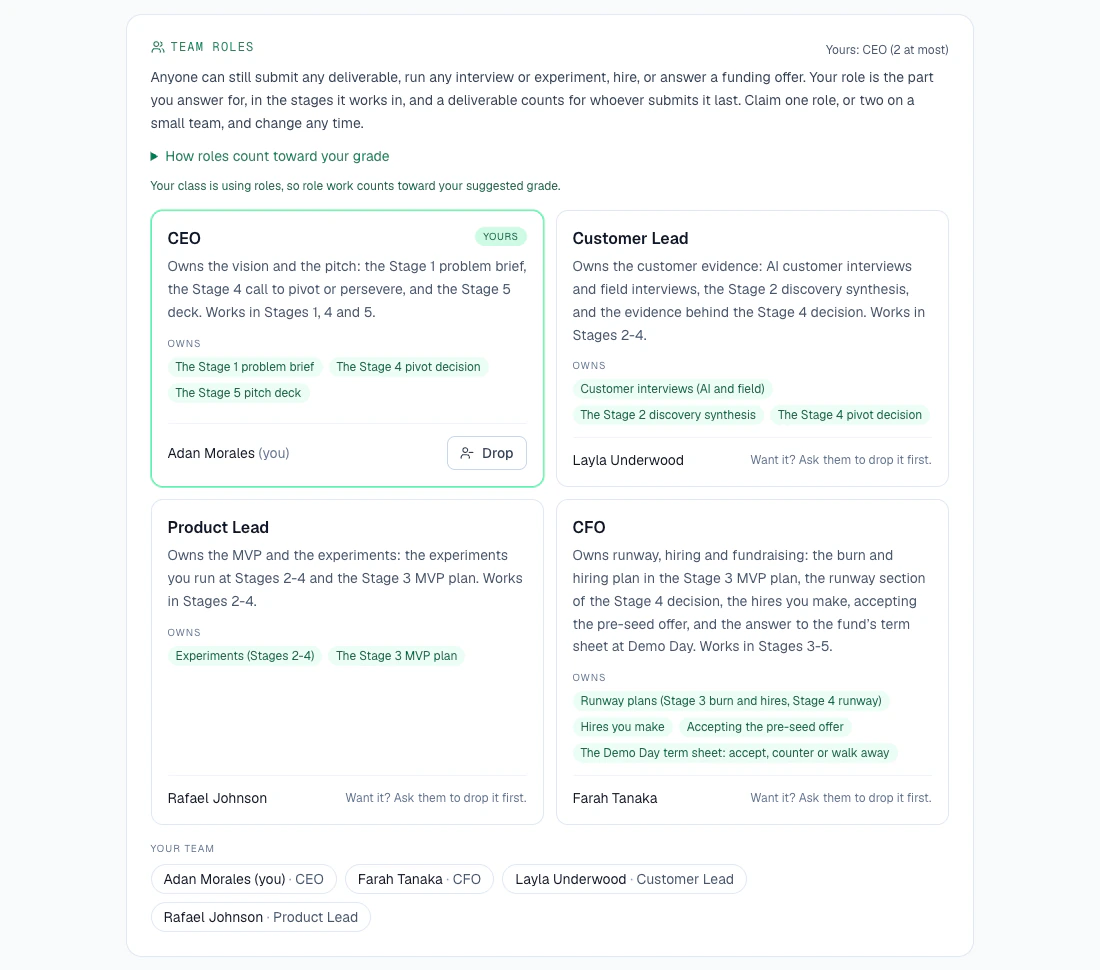
Every role has an owner: Startup Forge’s founders split the work, and each one’s name is on it. See Startup Forge
04 · Engagement
Competition, feedback and decisions that play out.
Students have been conditioned to show up, listen, submit, test. That rhythm has a place.
But a well-designed simulation adds something lectures can’t: head-to-head competition, real-time feedback, leaderboards, and the chance to see their decisions actually play out. That’s the stuff that sticks.
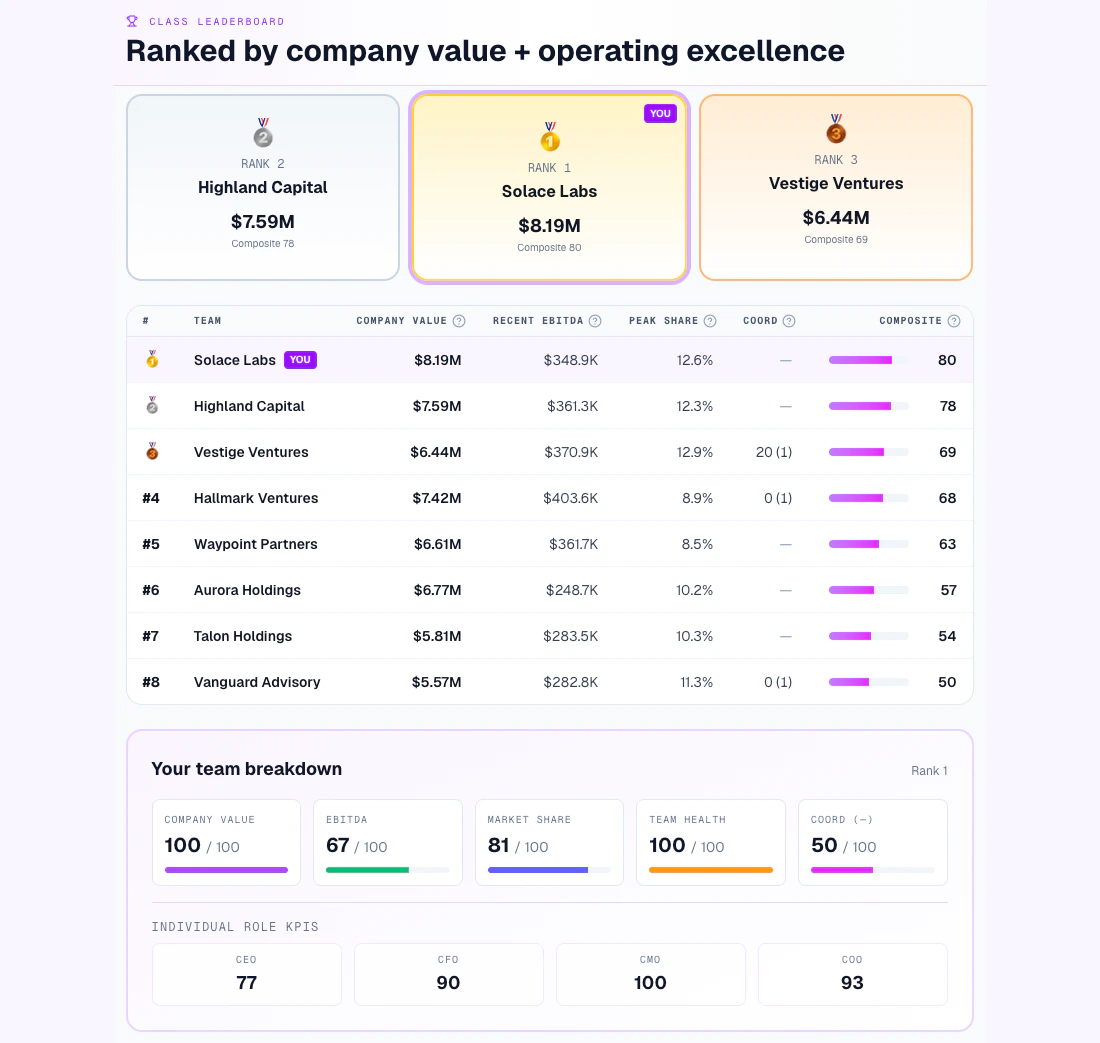
Head to head: teams ranked on company value and operating excellence, with a KPI for every seat. See The Boardroom
Where do I start?
Start with The Boardroom
If you teach strategy, capstone or general business, start with The Boardroom. It runs across multiple industries and difficulty levels, so students can play it more than once and get a different experience each time.
With a professor driving it, it teaches a layer of business judgment that lectures and textbooks can’t fully reach on their own.
If this resonates, I’d love to show you the platform.
I run every demo personally.
Sources
- Freeman, S., et al. (2014). Active learning increases student performance in science, engineering, and mathematics. PNAS, 111(23). doi.org/10.1073/pnas.1319030111
- Stanford Institute for Human-Centered AI (2026). The 2026 AI Index Report. hai.stanford.edu
- Lumina Foundation and Gallup (2026). State of Higher Education, fielded October 2025 with 3,801 students; reported in “AI Is Routine for College Students, Despite Campus Limits.” news.gallup.com
- “Brown Professor Suspects Most of His Class Used AI to Cheat,” Inside Higher Ed, July 8, 2026. insidehighered.com